
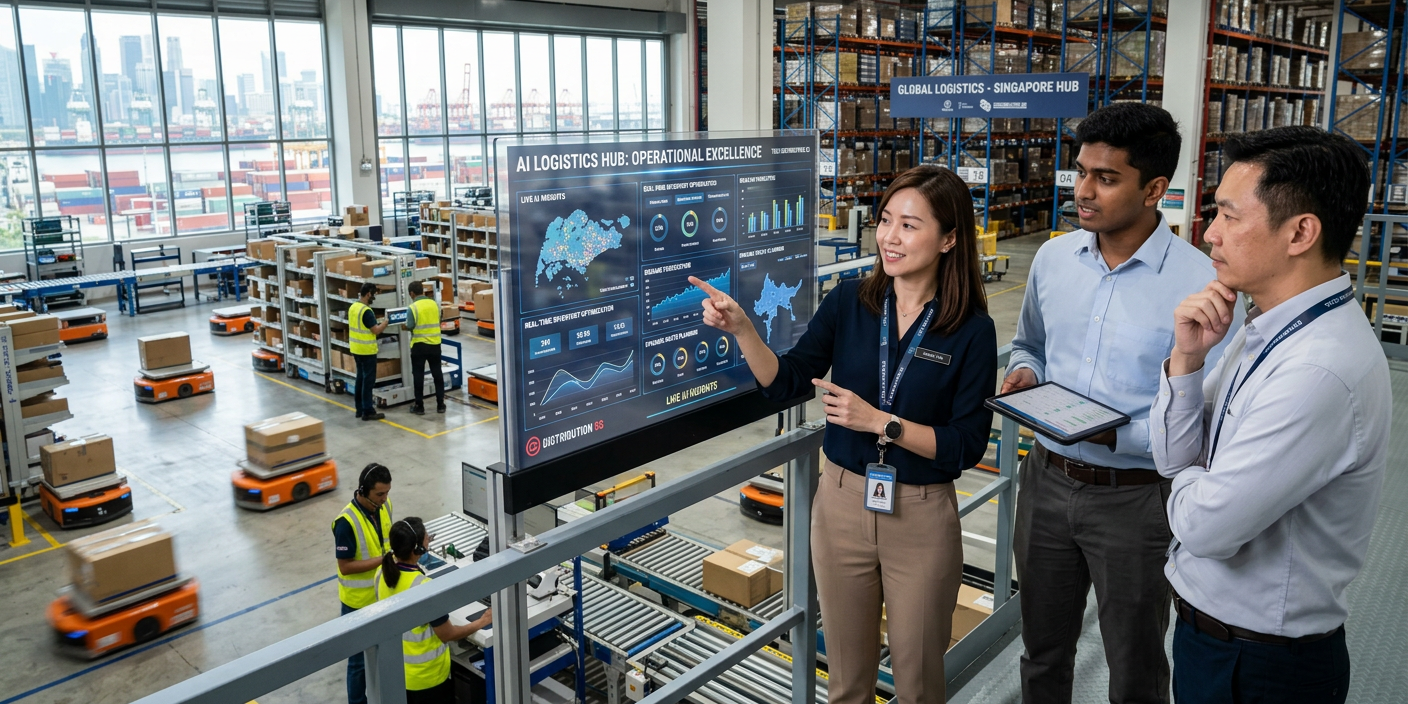
How AI Can Help Singapore Distributors Innovate, Transform, and Lead
Meta Description: Discover how AI helps Singapore distributors improve forecasting, inventory, warehousing, service, and financial control through connected operations.
Singapore’s distribution businesses are under pressure from every angle. Margins are tighter. Customers expect faster responses and better service. Inventory has become harder to balance. Regional supply chains are less predictable. At the same time, many distributors are still relying on disconnected systems, spreadsheets, manual reporting, and tribal knowledge to run critical decisions.
That model is running out of road.
For complete distribution businesses in Singapore, AI is no longer just a future idea or an experiment for large enterprises. It is becoming a practical way to run a more responsive, better-controlled business. But the real value does not come from adding AI on top of fragmented processes. It comes from building an integrated operating model where data, workflows, and decision-making work together across sales, inventory, purchasing, warehousing, finance, and leadership.
The distributors that move first have an opportunity to do more than automate. They can innovate in how they forecast and serve customers, transform how the business operates day to day, and lead with clearer insight and stronger control.
Innovate with better forecasting and smarter inventory decisions
Most distributors do not struggle because they lack data. They struggle because the data sits in too many places and arrives too late to support action.
Sales history may sit in one system. Purchase planning may live in spreadsheets. Warehouse activity may be updated separately. Finance may only see the impact after the fact. The result is familiar: stockouts on fast-moving items, excess stock on slow-moving lines, rushed purchasing decisions, and working capital tied up in the wrong places.
An AI-enabled operating model changes that by using connected business data to improve forecasting and replenishment. Instead of relying only on historical averages or manual guesswork, distributors can identify trends earlier, spot unusual demand shifts, and make more informed purchasing decisions.
For example, a distributor supplying commercial equipment across Singapore and the wider region may notice demand increasing in one product category while lead times are also stretching. In a manual environment, that risk may only become visible after orders are delayed. In a connected AI-driven model, the business can flag demand patterns, inventory exposure, supplier risk, and reorder priorities earlier, giving teams time to respond before service levels suffer.
This is where innovation becomes practical. Better forecasting is not about perfect prediction. It is about reducing blind spots, improving replenishment timing, and making stock decisions with more confidence.
Transform operations by connecting sales, warehouse, purchasing, and finance
Many distribution businesses have grown around functional silos. Sales teams focus on orders. Warehouse teams focus on fulfilment. Purchasing teams focus on supplier availability. Finance teams focus on reporting and control. Each team works hard, but the business still suffers when information does not flow cleanly across functions.
AI delivers the strongest results when these workflows are connected.
When sales orders, available stock, inbound supply, customer commitments, and financial exposure are all visible in one operating model, daily decisions get faster and better. Teams can identify exceptions earlier. Leaders can act before small issues become costly problems.
Take a common example. A customer places an urgent order for a key stock item. The sales team sees demand. The warehouse sees available quantity. Purchasing knows a supplier delivery is running late. Finance knows the customer’s credit position and margin profile. In a disconnected setup, each team works separately, often causing delay, rework, or bad decisions. In an integrated environment, those signals come together quickly, and the business can respond with clarity.
This is not just about efficiency. It is about redesigning operations so the whole business works from the same version of reality.
What day-to-day work looks like in an AI-enabled distribution business
In an AI-enabled distribution business, teams do not spend most of their day hunting for information, cleaning spreadsheets, or reacting to surprises. They spend more time acting on useful insight.
A sales manager starts the day with visibility into delayed orders, at-risk accounts, likely repeat orders, and items with limited stock availability. A purchasing manager sees suggested replenishment priorities based on demand movement, current stock, supplier lead times, and working capital limits. A warehouse supervisor sees which tasks should be prioritised to keep service levels high and reduce bottlenecks during peak periods. A finance leader reviews margin exceptions, overdue receivables, and projected cash flow impact without waiting for manual consolidation.
Leadership no longer waits until month-end to understand what happened. They can see what is changing now.
That shift matters in Singapore’s distribution environment, where lean teams often carry heavy workloads and where responsiveness can be a competitive advantage. AI should not replace operational judgment. It should strengthen it by helping people work with clearer signals, less manual effort, and better timing.
Lead with stronger visibility, financial control, and faster decisions
Distribution businesses do not fail because they lack activity. They fail because leaders cannot always see problems soon enough.
Margin leakage, ageing inventory, delayed fulfilment, rising carrying costs, and customer service issues often build quietly across the business. By the time they show up clearly in reports, the damage is already done.
A connected AI-enabled model gives leaders earlier warning and better control. Instead of relying on static reports, they can monitor live indicators across sales, stock, purchasing, warehouse activity, and finance. That means faster identification of slow-moving inventory, reduced exposure to supply disruption, earlier visibility into cash flow pressure, and better control over gross margin performance.
This is especially valuable for managing directors, finance heads, and operations leaders who need to balance growth with discipline. Growth without visibility creates risk. AI-backed visibility helps leaders make confident decisions based on current business conditions, not outdated summaries.
Leading with data does not mean drowning in dashboards. It means knowing where attention is needed and being able to act quickly.
Why strategy, integration, and adoption matter as much as the technology
This is where many AI initiatives go wrong. Businesses focus on tools before they are clear on process, data quality, and business priorities.
A distributor may want better forecasting, but if item data is inconsistent, stock movements are not accurate, or key decisions still happen outside core workflows, the results will be limited. The same applies to customer service, warehouse optimisation, and financial insight. AI amplifies what is already there. If the operating model is fragmented, the outputs will be fragmented too.
That is why a consulting-led approach matters. The first step is assessing digital maturity, data readiness, and operational bottlenecks. The second is defining a roadmap based on business priorities, not chasing every possible use case at once. From there, the focus should be on connecting workflows, building user trust, training teams, and setting clear governance around access, accountability, and decision use.
Adoption is not a side issue. It is central to success. Even strong solutions fail if teams do not understand how to use them or do not trust the output. The goal is not just implementation. It is operational change that sticks.
A practical roadmap to get started without disrupting operations
For most distributors, the right approach is phased, not dramatic.
Start by identifying where the business is losing time, margin, or control. That may be forecasting, replenishment, warehouse coordination, month-end reporting, or exception management. Then assess the quality of the underlying data and how disconnected the current workflows are.
The next step is to prioritise use cases that deliver visible operational value with manageable change. For one business, that may be inventory forecasting and replenishment planning. For another, it may be delayed order visibility and customer service responsiveness. For a third, it may be margin control and management reporting.
Once priorities are clear, connect the relevant data and workflows so teams can act from a shared view. Then support rollout with role-based training, clear accountability, and practical change management. Finally, measure outcomes. Look at forecast accuracy, stock availability, inventory turns, fulfilment performance, response time, reporting effort, and margin improvement. Refine from there.
This approach reduces disruption because it respects how distribution businesses actually operate. It builds momentum through targeted wins while creating the foundation for broader transformation.
How INFOC helps distribution businesses turn AI strategy into execution
For many distributors, the challenge is not knowing that AI matters. The challenge is knowing where to start, what to prioritise, and how to move forward without disrupting daily operations. This is where a consulting-led approach becomes valuable.
INFOC helps companies begin by assessing digital maturity, data readiness, and process bottlenecks across the business. That means looking closely at how sales, purchasing, inventory, warehousing, finance, and reporting currently work, where the gaps are, and where the biggest opportunities for improvement sit.
From there, INFOC helps define a phased roadmap based on business priorities. Rather than pushing a big-bang transformation, the focus is on practical steps that create measurable gains in visibility, control, and productivity. This includes connecting data and workflows across departments, reducing manual handoffs, and building a stronger foundation for AI-driven insight and automation.
INFOC also supports implementation, integration, and optimisation so businesses can move from strategy to execution with less friction. That includes aligning processes, improving reporting structures, and helping ensure that solutions fit the way the business actually runs.
Just as important, INFOC helps organisations drive adoption through training, support, and change management. AI and automation only create value when teams understand how to use them, trust the outputs, and can apply them confidently in day-to-day decision-making.
As businesses scale, INFOC’s approach also emphasises governance, security, and continuous improvement. That helps distributors adopt AI in a way that is practical, accountable, and built for long-term value rather than short-term experimentation.
For Singapore distribution businesses looking to innovate, transform, and lead, the right partner is not just a technology provider. It is a consulting team that can align business goals, operational realities, and AI opportunities into a roadmap that delivers results.
Conclusion
AI is becoming a practical advantage for complete distribution businesses in Singapore, but only when it is tied to business outcomes. The real opportunity is not to add another layer of technology. It is to build a connected operating model that improves forecasting, stock planning, warehouse execution, customer responsiveness, financial control, and leadership decision-making.
That is how distributors innovate with better visibility, transform how work gets done, and lead with more confidence in a demanding market.
The businesses that act now can reduce stock risk, improve service, strengthen margins, and create a more resilient operation for the years ahead. The best place to start is not with hype. It is with a clear assessment of current maturity, a practical roadmap, and a focused plan to turn AI into measurable business value.