Microsoft IQ Explained: How Work IQ, Foundry IQ, and Fabric IQ Are Reshaping Enterprise AI
Enterprise AI is entering a more serious phase. It is no longer enough for AI to generate text, summarize meetings, or answer broad questions. To create real business value, AI needs context. It needs to understand how work happens, where trusted knowledge lives, and what business data actually means. That is the direction Microsoft is pushing with Microsoft IQ through three connected layers: Work IQ, Foundry IQ, and Fabric IQ.
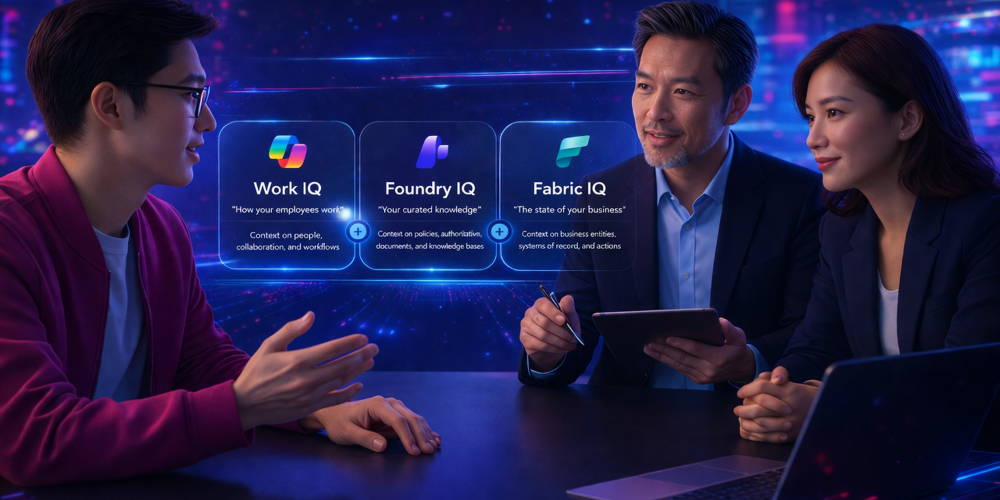
At a practical level, Microsoft IQ can be understood as a multi-layered enterprise intelligence model. Work IQ brings context from collaboration, communication, and workflow signals. Foundry IQ brings permission-aware enterprise knowledge into AI interactions. Fabric IQ brings semantic understanding to business data by organizing it according to the language of the business. Together, these layers point toward a model of enterprise AI that is more grounded, more context-aware, and more useful for real business execution.
This matters because most enterprise AI projects do not fail because the model is weak. They fail because the surrounding context is weak. AI may have access to too little information, the wrong information, or information that lacks business meaning. Microsoft IQ is Microsoft’s answer to that problem. It is an attempt to move enterprise AI from isolated prompts toward connected intelligence.
What Microsoft IQ Means for Enterprise AI
Microsoft IQ is important because it reflects a shift in how enterprise AI is being designed. Instead of treating productivity data, enterprise content, and operational data as separate worlds, Microsoft is increasingly positioning them as connected layers of context for AI agents and copilots. That means the future of enterprise AI is not just about model quality. It is about how well AI can understand work patterns, retrieve trusted knowledge, and reason over business meaning.
For business leaders, this changes the conversation. The question is no longer only which AI tool to adopt. The real question is whether the organization is ready to give AI the context it needs to be accurate, useful, and trustworthy. Microsoft IQ suggests that the enterprises that gain the most value from AI will be the ones that can connect productivity signals, governed knowledge, and semantic data into one working model.
Work IQ: The Layer That Understands How Work Happens
Microsoft describes Work IQ as the intelligence layer that grounds Microsoft 365 Copilot and agents in real-time, shared context across the organization. It connects signals from files, emails, meetings, chats, and business systems to support personalized search, deeper semantic understanding, and stronger reasoning. Microsoft also frames Work IQ around three tightly integrated layers: Data, Memory, and Inference.
That structure matters. Data captures how work happens across the organization. Memory helps build persistent understanding of how people and teams operate. Inference brings together models, skills, and tools so agents can reason and take action with governance in place. In simple terms, Work IQ is meant to help AI understand the flow of work rather than respond to prompts in isolation.
In an enterprise setting, that can improve how AI supports tasks such as finding the right document, surfacing relevant meeting decisions, identifying who is involved in a project, or connecting a user’s question to the correct workflow or source. Microsoft is clearly moving beyond the idea of AI as just a writing assistant. Work IQ shows a push toward AI that can operate with live organizational context.
There is also a governance message built into Work IQ. Microsoft highlights centralized control, scoped permissions, observability, and policy enforcement through its management model. That is important because enterprise AI becomes risky when it can access broad information without clear boundaries. Work IQ suggests Microsoft is trying to combine contextual intelligence with enterprise-grade control.
Foundry IQ: The Layer That Turns Enterprise Knowledge Into Agent-Ready Context
If Work IQ explains how employees work, Foundry IQ explains how AI gets access to knowledge. Microsoft describes Foundry IQ as a managed knowledge layer for enterprise data that connects structured and unstructured information across Azure, SharePoint, OneLake, and the web so agents can access permission-aware knowledge.
This is a critical layer because enterprise AI often fails at retrieval before it fails at generation. If AI pulls the wrong source, retrieves outdated content, or surfaces information a user should not have access to, the answer may still sound convincing while being operationally wrong. Foundry IQ addresses that by positioning retrieval as a managed and reusable knowledge layer rather than a simple one-step lookup.
Microsoft also ties Foundry IQ to knowledge bases and agentic retrieval. That matters because retrieval is no longer being treated as a passive search problem. It is becoming an active reasoning and orchestration problem. AI agents need the right content, the right permissions, and the right grounding logic before their answers can be trusted at scale.
The broader implication is clear: enterprise knowledge architecture is becoming a core part of AI strategy. Businesses need to think not only about where knowledge is stored, but how that knowledge is structured, governed, and exposed to AI systems. Foundry IQ is Microsoft’s attempt to make that process more systematic and reusable across agents.
Fabric IQ: The Layer That Gives AI Business Meaning
Fabric IQ is the semantic layer of the Microsoft IQ model. Microsoft describes it as a workload in Microsoft Fabric for unifying data across OneLake and organizing it according to the language of the business. That data is then exposed to analytics, AI agents, and applications with consistent semantic meaning and context.
This is where Microsoft’s enterprise AI direction becomes more ambitious. Businesses do not run on raw tables or disconnected data points. They run on customers, assets, contracts, revenue, service cases, inventory, orders, and other business entities. Fabric IQ is designed to help AI understand those business concepts consistently across systems.
Microsoft also describes Fabric IQ as including elements such as ontology, plan, graph, data agent, operations agent, and Power BI semantic models. That signals a move toward enterprise AI that can reason over relationships, business vocabulary, and shared definitions rather than simply summarize data. When AI can interpret business meaning more consistently, it becomes more useful for analytics, planning, automation, and operational decision support.
Fabric IQ also points to a larger truth about enterprise AI: strong results depend on a strong semantic foundation. If different teams define core business concepts differently, AI outputs will be inconsistent. If business entities are modeled well, AI becomes far more effective. Fabric IQ is Microsoft’s effort to create that consistency across analytics, agents, and applications.
Why These Three Layers Matter Together
Each IQ layer solves a different enterprise AI problem. Work IQ handles work context. Foundry IQ handles knowledge access and retrieval. Fabric IQ handles business semantics and the state of the business. On their own, each layer is useful. Together, they become much more powerful.
That combination is what makes Microsoft IQ strategically important. Enterprise AI is strongest when it can understand how employees are working, retrieve the right knowledge from trusted sources, and interpret data using the language of the business. This is the path from general-purpose AI toward enterprise-grade intelligence.
It also explains why Microsoft’s broader messaging increasingly emphasizes AI agents in business. Agents are not just there to answer questions. They are being positioned to support workflows, improve decision-making, and help organizations execute work more effectively. For that to happen, they need context. Microsoft IQ is designed to provide it.
5 Adoption Strategies for Leaders
1. Start with a business workflow, not the technology stack.
Leaders should begin with a high-value workflow where all three context layers matter together. Customer service, sales operations, procurement, internal knowledge support, and finance operations are good examples. This keeps enterprise AI focused on measurable business outcomes instead of broad experimentation with unclear payoff.
2. Treat context quality as a leadership issue, not just an IT issue.
Microsoft IQ depends on clean collaboration signals, trusted knowledge, and well-defined business data. If the organization’s content is scattered, outdated, duplicated, or poorly governed, AI quality will suffer. Leaders need to sponsor data governance, content hygiene, and business terminology alignment early rather than treating them as back-office cleanup tasks.
3. Build a shared operating model across productivity, knowledge, data, and security teams.
Microsoft IQ spans Microsoft 365, Foundry, Azure AI Search, and Fabric. That means adoption should not sit in one silo. Workplace teams, security teams, data leaders, and business owners need a common operating model so AI is designed as part of an enterprise system, not as a disconnected pilot.
4. Put governance and permissions in place before scaling agents.
Microsoft’s guidance around Copilot and Work IQ makes the point clearly: accurate and secure AI depends on governed, current, and appropriately shared data. Leaders should define trusted sources, access policies, and monitoring standards before scaling agents widely. That is what separates a controlled enterprise rollout from a noisy proof of concept.
5. Scale in phases and prove value before industrializing.
Some parts of the Microsoft IQ story are still evolving, and preview capabilities are part of the current landscape. Leaders should avoid treating this as a one-step transformation. A better strategy is to prove value in one domain, refine governance and architecture, then expand to additional use cases once the organization has a repeatable model.
Final Wrap
Microsoft IQ shows where enterprise AI is heading. Work IQ is about how people work. Foundry IQ is about how enterprise knowledge is accessed and grounded. Fabric IQ is about how business data is interpreted through shared meaning. Together, they represent a more mature model for enterprise AI — one built on context, trust, and operational relevance rather than generic outputs.
For businesses, that creates both opportunity and pressure. The opportunity is clear: more useful agents, better grounded AI, and stronger support for business decisions and workflows. The pressure is just as real: organizations need the right cloud foundation, governance discipline, knowledge structure, and data maturity to make the model work.
This is where INFOC can help in a practical way. As businesses move toward enterprise AI, INFOC can support the foundations behind that journey across Microsoft Azure, Microsoft Fabric, Power BI, and Dynamics 365. The goal is not to make INFOC the center of the story, but to help organizations turn Microsoft’s enterprise AI direction into something secure, connected, and usable in the real world.
Official Microsoft References
- Work IQ MCP overview (preview) – Microsoft Learn
- Configure a secure and governed foundation for Microsoft 365 Copilot – Microsoft Learn
- What is Foundry IQ? – Microsoft Learn
- Foundry IQ FAQ – Microsoft Learn
- What is Fabric IQ (preview)? – Microsoft Learn
- What is Microsoft Fabric? – Microsoft Learn
- Business plan for AI agents – Microsoft Learn
- AI agents and business – Microsoft