
Building a Stronger Digital Core with Microsoft
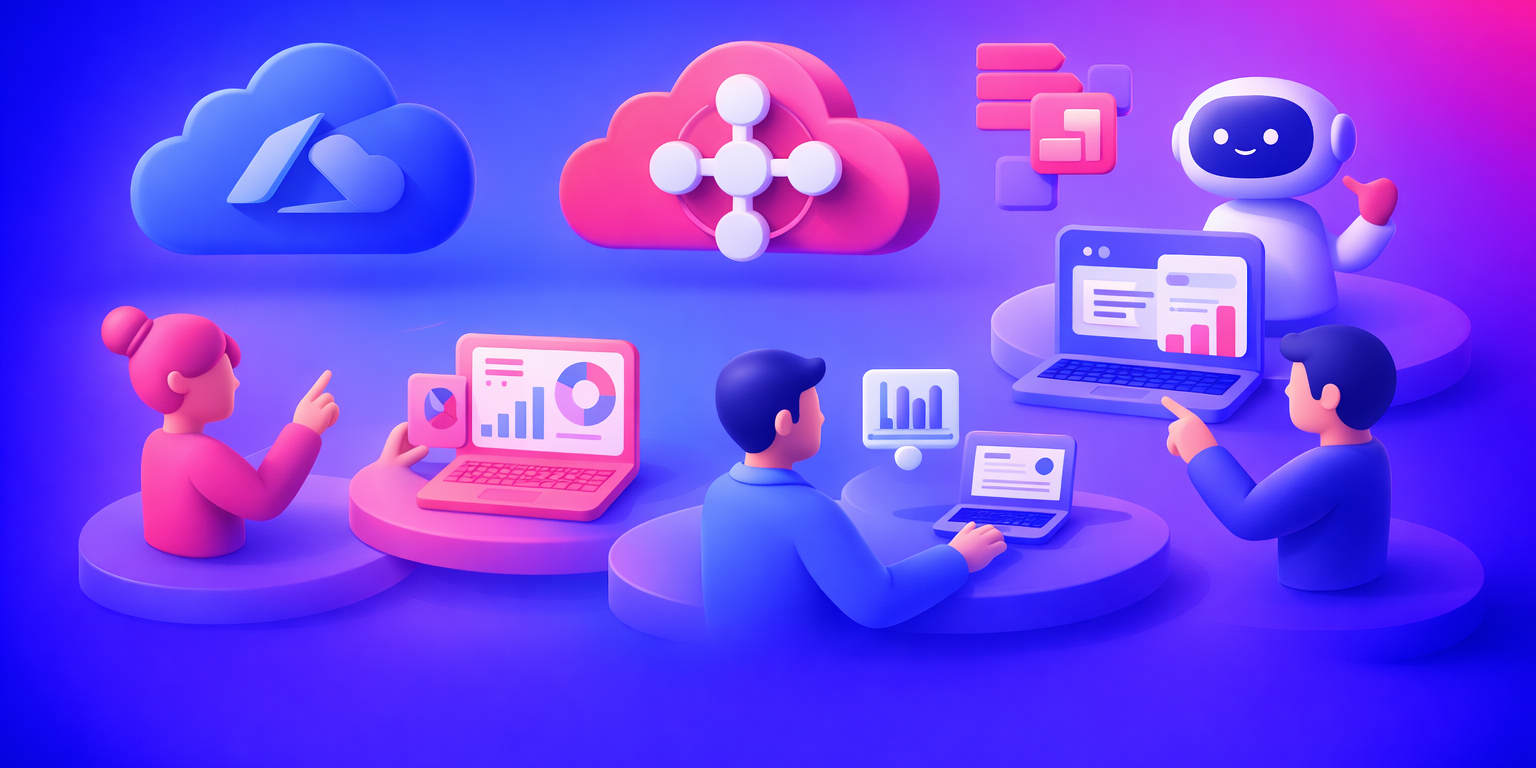
Organizations that want to grow, adapt, and stay resilient need more than isolated technology upgrades. They need a connected digital foundation: one that is secure, scalable, operationally disciplined, data-driven, and practical for everyday users. Microsoft’s ecosystem makes that possible by linking cloud infrastructure, business applications, analytics, and AI into a more unified operating model.
Azure provides the cloud foundation, Business Central modernizes finance and operations, Microsoft Fabric unifies data and analytics, and Microsoft 365 Copilot brings AI into daily work. Together, they create a platform for resilience, flexibility, and future growth.
Foundation: Microsoft Azure
A strong digital strategy starts with the platform underneath it. Microsoft positions Azure landing zones as the recommended, standardized approach for setting up and managing Azure environments at scale. That matters because growth without structure usually leads to sprawl, inconsistent controls, and rising operational risk.
Azure landing zones are designed to create a well-architected foundation aligned to security, compliance, and operational efficiency, while separating platform services from application environments so organizations can scale in a more controlled way.
Azure’s value is not just in hosting workloads in the cloud. It is in creating an environment that supports resilience and disciplined growth from the start. Microsoft’s Well-Architected Framework centers that foundation around five pillars: reliability, security, cost optimization, operational excellence, and performance efficiency. For leadership teams, that means Azure is not just infrastructure; it is a framework for building digital capability that can evolve without constantly being rebuilt.
Operations: Dynamics 365 Business Central
Once the platform is in place, the next challenge is operational control. Many organizations still run finance and operations across fragmented tools, disconnected spreadsheets, and manual handoffs. Business Central is designed to bring core business processes together across finance, manufacturing, sales, shipping, project management, and service management, while also connecting with Microsoft tools such as Outlook, Excel, Teams, Power Automate, and Power BI.
That kind of integration improves visibility and reduces the friction that slows execution. From a finance and governance perspective, Business Central supports financial management, accounting, auditing, and bookkeeping. It also includes change logging capabilities that help organizations see what changed, who changed it, and when the change happened.
That is a practical improvement for leaders who need stronger control, better traceability, and cleaner decision-making across the organization. Instead of chasing information across systems, finance and operations teams can work from a more consistent operational backbone.
The bigger value is modernization. Business Central is not just about replacing legacy ERP functionality. It is about improving process discipline, increasing transparency, and creating a more reliable operating model for growth. When finance and operations become more connected, management gets better oversight, teams spend less time reconciling issues manually, and the organization becomes easier to scale.
Data + Intelligence: Microsoft Fabric
Modern organizations do not just need more reports. They need a better way to bring data together so it can actually support decisions. Microsoft Fabric is built as an end-to-end analytics platform that covers ingestion, transformation, real-time processing, analytics, and reporting across a shared compute and storage model.
Microsoft’s positioning is clear: Fabric is intended to reduce fragmentation by unifying the data lifecycle on one platform rather than spreading it across disconnected tools and services. A major part of that story is OneLake, which Microsoft describes as a single, unified, logical data lake for the entire organization.
Because OneLake is included with every Fabric tenant, it gives organizations a common data layer designed to reduce duplication and support multiple analytical engines from a shared data foundation. Power BI is also a core component of Fabric, which means reporting and visualization are not bolted on separately; they are part of the broader analytics architecture.
For management teams, this matters because better decisions depend on cleaner access to data and faster movement from data to insight. Fabric helps create that by bringing data engineering, data integration, warehousing, real-time analytics, data science, and reporting into one environment. It also supports scenarios where data is integrated, transformed, and stored to train AI models, which makes it a stronger foundation for AI-driven decision-making rather than just retrospective reporting.
Productivity + AI: Microsoft 365 Copilot
AI only delivers value when it fits into the way people already work. Microsoft 365 Copilot is designed around that principle. Microsoft describes Copilot as working within Microsoft 365 experiences while honoring existing permissions, Conditional Access policies, and the broader security, compliance, and privacy protections already present in Microsoft 365.
That is important because it positions AI as an operational tool inside the business, not as a disconnected experiment outside normal governance. In practical terms, Copilot can help reduce time spent on repetitive work, accelerate drafting and summarization, and improve day-to-day execution by embedding assistance into common workflows.
Microsoft also states that Microsoft 365 Copilot operates with multiple protections, including blocking harmful content and blocking prompt injections, while its architecture is designed around enterprise data protection and auditing considerations. For organizations trying to move from AI interest to AI usage, that makes Copilot a more credible path to adoption.
The real opportunity is not replacing people. It is helping teams spend less time on low-value repetition and more time on judgment, coordination, and action. When used properly, Copilot can improve execution quality across the organization while keeping AI grounded in the tools employees already use every day.
Why This Microsoft Stack Works Together
What makes this approach compelling is not any single product on its own. It is the way the pieces reinforce each other. Azure provides the secure and scalable foundation. Business Central modernizes financial and operational control. Microsoft Fabric connects data, reporting, and analytics into a stronger intelligence layer. Microsoft 365 Copilot then brings AI into the daily flow of work.
That progression is logical: infrastructure first, operational discipline second, intelligence third, and user productivity on top. For organizations planning the next phase of digital transformation, the message is straightforward. Do not treat infrastructure, ERP, data, and AI as separate investments. Build them as part of one connected architecture.
That is how you create a more secure, scalable digital foundation that supports resilience, flexibility, stronger control, better insight, and more practical use of AI across the business.
How INFOC Can Help
Technology on its own does not deliver transformation. The real value comes from aligning platform decisions, business processes, data strategy, and user adoption into one practical roadmap. That is where Infoc can help.
Infoc helps organizations build a stronger Microsoft-based digital foundation by connecting strategy with execution. From Azure foundation design and cloud readiness to Business Central implementation, Microsoft Fabric analytics enablement, and Microsoft 365 Copilot adoption, Infoc supports each stage with a business-led approach focused on control, usability, and measurable outcomes.
On the infrastructure side, Infoc can help design and implement a secure, scalable Azure environment that supports long-term resilience and growth. For operations, Infoc can help modernize finance and business processes with Business Central to improve visibility, strengthen governance, and reduce manual inefficiencies.
For data and intelligence, Infoc can help unify reporting, analytics, and data management with Microsoft Fabric so leadership teams can make faster, better-informed decisions. For productivity and AI, Infoc can help organizations introduce Microsoft 365 Copilot in a practical way by focusing on readiness, governance, use-case alignment, and user adoption.
The result is a more connected transformation approach: one that does not treat cloud, ERP, analytics, and AI as separate projects, but as part of a single digital ecosystem. Infoc helps organizations move from fragmented systems and siloed decision-making toward a more secure, data-driven, and execution-focused operating model built for future growth.
Official Microsoft References
- Azure landing zones overview
- Azure Well-Architected Framework
- Secure cloud adoption and landing zones
- Dynamics 365 Business Central overview
- Business Central financial management
- Business Central auditing and change log
- Microsoft Fabric overview
- OneLake overview
- Power BI overview
- Microsoft Fabric data lifecycle
- Microsoft 365 Copilot privacy
- Microsoft 365 Copilot security
- Microsoft 365 Copilot architecture